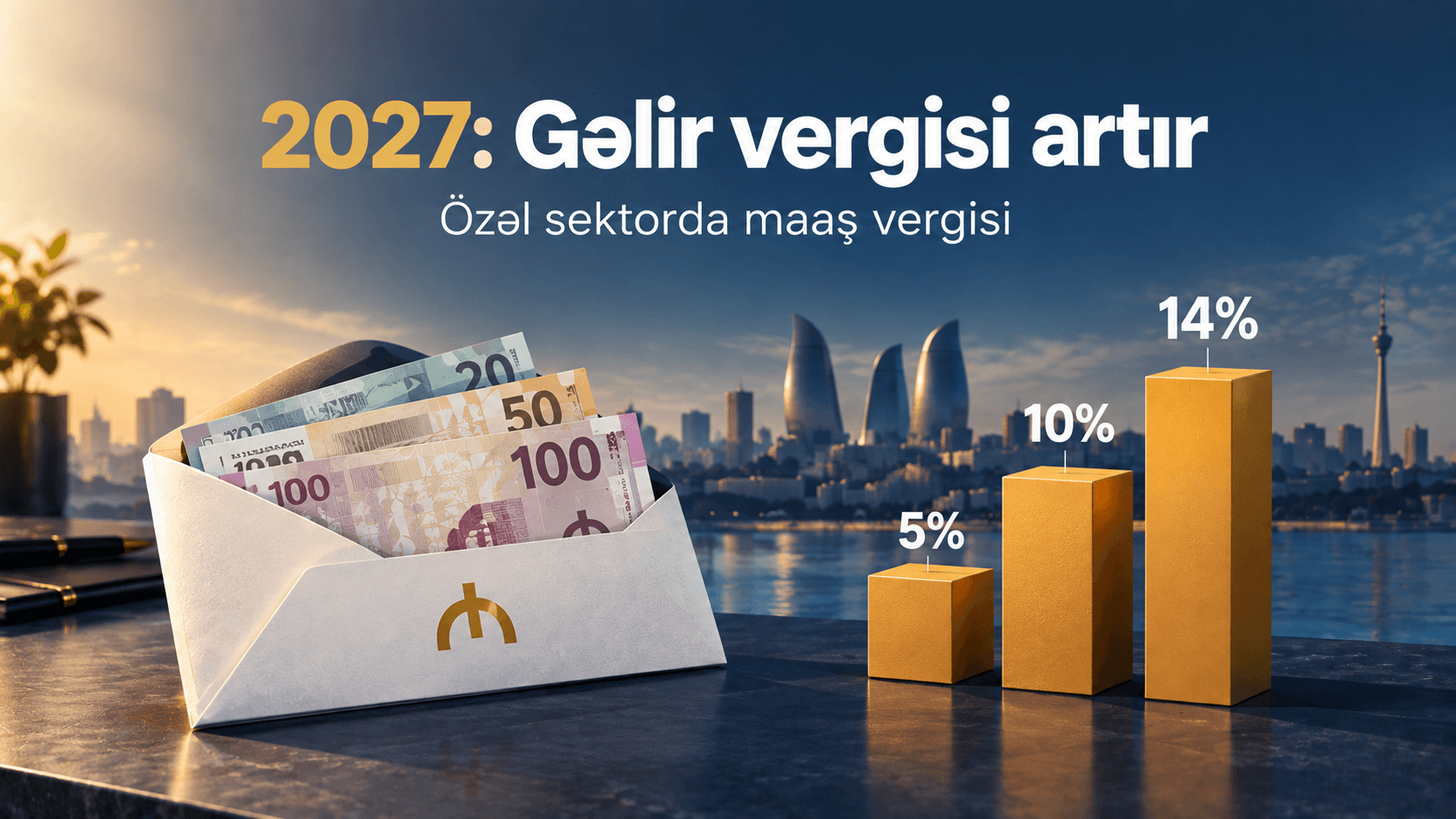
A private-sector employee in Baku earning 1,500 AZN per month paid no income tax at all in 2025. In 2026, 39 AZN a month began to be withheld. From 1 January 2027, that figure rises to 65 AZN — nearly double in the space of one year.
The change stems from amendments to the Tax Code. The new rates apply from 1 January 2027 to 31 December 2027 and cover employees of private companies outside the oil and gas sector.
How the new scale works
Under the updated rules, income tax is calculated as follows:
| Monthly income | 2026 rate | 2027 rate |
|---|---|---|
| Up to 2,500 AZN | 3% | 5% |
| 2,500–8,000 AZN | 75 AZN + 10% | 125 AZN + 10% |
| Above 8,000 AZN | 625 AZN + 14% | 675 AZN + 14% |
For employees earning up to 2,500 AZN per month, the 200 AZN tax-free allowance remains in place. Tax is applied only to income above that threshold.
The largest percentage shift is in the lower bracket — from 3% to 5%. But the fixed amounts in the two higher brackets also rise by 50 AZN, meaning every employee earning over 2,500 AZN will pay an extra 50 AZN per month, or 600 AZN per year.
The numbers in practice
Comparative calculations for three typical salary levels:
| Monthly salary | Tax in 2026 | Tax in 2027 | Monthly difference |
|---|---|---|---|
| 1,500 AZN | 39 AZN | 65 AZN | +26 AZN |
| 4,000 AZN | 225 AZN | 275 AZN | +50 AZN |
| 9,000 AZN | 765 AZN | 815 AZN | +50 AZN |
These figures cover income tax only. Social insurance contributions (3% from the employee), unemployment insurance (0.5%) and compulsory health insurance (2%) are deducted separately on top.
Want to calculate the exact net amount for your own salary? Salary calculator →
From tax holiday to phased taxation
The private sector "tax holiday" began in 2019, when monthly incomes up to 8,000 AZN in the non-oil, non-government sector were fully exempt from income tax for seven years. That exemption expired at the end of 2025. Rather than removing it in one step, the government chose a gradual phase-in of the tax burden.
2027 is the midpoint of that transition. From 1 January 2028, the lower bracket will rise to 7%, with fixed amounts of 175 AZN and 725 AZN respectively.
What it means for the state budget
The fiscal rationale is straightforward. The government plans to collect 3.1 billion AZN in personal income tax in 2027 — 29% more than the approved forecast for 2026.
What employers and employees need to do
Employers must update their payroll systems before the first January pay run. Particular attention should be paid to employment contracts specifying a "net salary": in such contracts, any increase in the tax burden typically falls on the employer.
Employees are advised to compare their January pay slip with December's. For a salary of 1,000 AZN the difference is just 16 AZN; for 1,500 AZN it is 26 AZN. For incomes above 2,500 AZN the monthly increase is a fixed 50 AZN — 600 AZN over the full year — and will rise further in 2028.
Tax Code of the Republic of Azerbaijan, Article 101.1 (as amended by the Law of 30 December 2025).